
Experiment 4: Part I (Scaling Task)
You know:
Instructions: Read the story and rate each word, presented after it, for the appropriateness of the emotion the main character is likely to feel in the described story ('1' - 'not appropriate' ... '6' - 'very appropriate'). When you are finished click the ‘Next’ button to see the next story.
Anthony and Julia have known each other since they first met in the 8th grade. Now they are grown-ups and their friendship has developed into a romantic relationship. Anthony appreciates the mutual trust in their relationship, but the events of the last week made him doubt Julia's faithfulness. A few days ago when he called her late at night, a male voice he has never heard before answered the phone, and yesterday Anthony saw Julia at a café engaged in a conversation with an attractive man.
Boris and Natasha are a married couple. They are very happy together and want to have a big family with a lot of kids. However, they found out that they'll never be able to have their own children. The only option they have is adoption that is a long and complicated process. Last weekend they went to visit their friends whom they've known since they were college students. These friends of Boris and Natasha's just had their second baby who is incredibly beautiful and looks a lot like her parents.
Paul and Max are friends. They are college seniors and they both dream of working for the same company - IBM. Having done equally well on their interviews, they were both offered three-month internships. After their internship was over Paul and Max applied for the same job at IBM. However, despite them both beging equally well qualified, Max got the job and Paul did not.
Marina and Andrew have been friends ever since they first met in the 10th grade. Many years have passed and their friendship developed into a romantic relationship. Marina is very committed to Andrew, but she's beginning to doubt whether he feels the same way. She was unpleasantly surprised a few days ago when she saw Andrew not only dancing but also flirting with one of her friends at a party, and yesterday Andrew mentioned that he is going away for a weekend to visit his former girlfriend.
Anna and Maria are friends. It's their last year of training in a theater/acting college and they both dream of playing Ophelia in their favourite play 'Hamlet'. Unexpectedly, they get a chance to audition for this role in a theater. Anna and Maria's instructor thinks that both women are very talented and are equally fit to play this role. However, after the audition the role was offered to Maria, and not to Anna.
| Jealous | |
| Upset | |
| Glad | |
| Surprised | |
| Envious | |
| Sad |
Инструкция: Прочтите историю и оцените, на сколько каждое слово подходит для описания эмоций, которые человек, вероятно, будет испытывать в описанной ситуации ("1" - "не вероятно" ... "7" - "очень вероятно"). После оценки всех слов нажмите кнопку "Далее", чтобы увидеть следующую историю.
Антон и Юлия знают друг друга с 8-го класса, где они и познакомились. Сейчас они взрослые и их дружба переросла в романтические отношения. Антон ценит взаимное доверие, установившееся в отношениях, но события последней недели заставили его усомниться в верности Юлии. Несколько дней назад, когда Антон позвонил ей домой поздно вечером, ему ответил незнакомый мужской голос, а вчера он случайно увидел Юлию в кафе, сидящую за столиком с привлекательным мужчиной и увлеченную разговором с ним.
Борис и Наталия женаты. Они очень счастливы и хотят иметь большую семью и много детей. Однако они узнали, что никогда не смогут иметь своих собственных детей. Их единственный выход - усыновление - долгий и сложный процесс. На прошлые выходные они ездили в гости к друзьям, которых они знают со студенческих времен. У этих друзей только что родился второй ребенок - невероятно красивая девочка, очень похожая на родителей.
Павел и Максим - друзья. Они учатся на последнем курсе и оба мечтают работать на одну компанию - IBM. После того, как они одинаково успешно прошли собеседование, им обоим предложили трехмесячную практику в этой компании. По окончании практики Павел и Максим подали документы на одну и ту же открывшуюся вакансию IBM. Однако, несмотря на то, что они были одинаково квалифицированы, работу получил Максим, а не Павел.
Марина и Андрей были друзьями с тех пор, как они познакомились в 10-м классе. Прошло много лет и их дружба переросла в романтическин отношения. Марина очень привязана к Андрею, но она начала сомневаться в том, что Андрей испытывает сходные чувства. Несколько дней назад она была неприятно удивлена, увидев как Андрей не только танцевал, но и заигрывал с одной из ее подруг на вечеринке у друзей, а вчера Андрей упомянул, что уезжает на выходные навестить свою бывшую девушку.
Анна и Мария - подруги. Они учатся на последнем курсе театрального училища и обе мечтают сыграть Офелию в их любимой пьесе "Гамлет". Неожиданно у них появляется возможность участвоввать в прослушивании на эту роль в театре. Преподаватели Анны и Марии считают, что обе девушки очень талантливы и одинаково подходят на эту роль. Однако, после прослушивания роль предложили только Марии, а не Анне.
| Ревность | |
| Расстройство | |
| Радость | |
| Удивление | |
| Зависть | |
| Грусть |
Instructions:In each set pick any 2 situations that, in your opinion, go together. If you don't know, what to choose, select the last option ("Emm... Can't answer"). When you are finished, please, click the ‘Ready’ button to see your results for both parts of the experiment.
Инструкция: В каждом наборе выберите 2 ситуации, которые, на ваш взгляд, похожи. Если Вы затрудняетесь с ответом, выберите последнюю опцию ("Эммм... Затрудняюсь ответить.") После выполнения задания, пожалуйста, нажмите кнопку ‘Готово’, чтобы просмотерть Ваши результаты за обе части эксперимента.

| Envy Situations Story 2, Story 3, Story 5 |
Jealousy Situations Story 1,Story 4 |
||
Compare yourself with others' performance:
|
|||
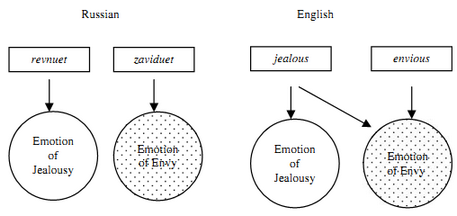
On the whole Russian speakers tend to apply term “zaviduet” only to “envy situations” and “revnuet” – only to “jealousy situation”. English speakers refer to “envy situations” with the both words (“envy” and “jealous”) almost equally, though still differentiating between their appropriateness in “jealousy situations”. |
 |
||
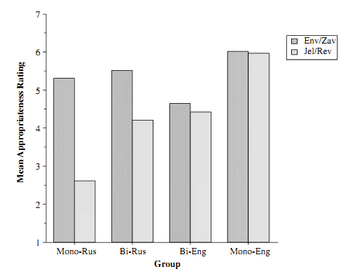
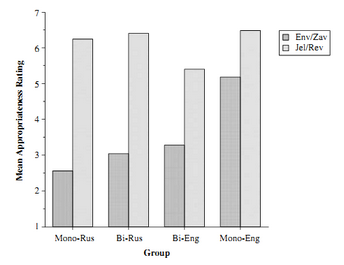
An interesting finding is that bilinguals performed in accordance with the language they were using in the experiment (either English or Russian). However, when using Russian in “envy situations” they performed though similarly to Russian monolinguals – but not exactly in the same way. In English they performed exactly as English monolinguals. Probably this is the awareness of overlapping concepts in English that influenced their performance? Probably they started to see jealousy and envy as something more similar? Let’s see your results for the second part of the experiment and try to answer these questions!
In the Sorting Task you were presented with triads of different situations. The experiment was intended to investigate whether the difference in how Russian and English speakers apply words “envious”/”zaviduet” and “jealous”/”revnuet” reflected a difference in conceptual perception of corresponding situations (do English speakers really see "envy" and "jealous" situations more similar and group them together"? Or is that just a matter of naming?). We were also interested if there is a conceptual shift in bilinguals’ mental lexicon, caused by the knowledge of L2. Here you may see your results and compare them with the previously documented performance in different language group.
| Triad Type | You groupedtogether | Target Answer | |||
| MR | BR | BE | EM | ||
| 1.JJE | JJ - 88% | JJ - 64% | JJ - 79% | JJ - 91% | |
| 2.EEJ | EE - 74% | EE - 73% | EE - 70% | EE - 74% | |
| 3.JJN | JJ - 75% | JJ - 73% | JJ - 82% | JJ - 91% | |
| 4.EEN | EE - 77% | EE - 68% | EE - 82% | EE - 84% | |
| 5.EJN | EJ - 21% | EJ - 59% | EJ - 50% | EJ - 52% | |
*J - "jealous situation", E - "envy situation", N - situation of general negative nature / MR - Russian monolinguals, BR - Russian bilinguals that performed the test in Russian, BE - Russian bilinguals that performed the test in English, EM - English monolinguals.
All 4 documented groups of speakers performed very similarly in the first 4 triads. Subjects consistently differentiated between "envy" and "jealous" situations, regardless of their native language and a language that they were currently using. In the last triad, as we expected, English speakers were more likely to see envy and jealous emotions as similar, than Russian monolinguals (in fact 50% of BR saw the 3 situations as so different, that they couldn't provide any answer). The interesting finding is that "envy" and "jealous" situation seemed more alike not only to English monolinguals and Russian bilinguals, that performed the task in English, but also to bilinguals that used Russian. Judging by the performance in the 5th triad, we may differentiate between people that were and were not exposed to English (either as L1 or as L2).
Go to the ‘Read’ page to get a brief summary of the experiment and find out, what that tells us about bilingual mental lexicon and language interference!