Interference

Having completed all the experiments we can now safely say that language transfer exists and one language, indeed, can have an effect upon the other. We have outlined that the mental lexicon is a collection of words’ meanings, pronunciation, syntactic characteristics and so on that a person possesses for every language he knows. Lexicons, in case of bilingualism, are connected with the concept storage, and interact with each other as well as with the pool of concepts an individual has.

Consequently, we may assume that these interactions are dynamic in nature as any language proficiency might change over a lifetime, and multi-directed. The latter here means that not only a mother tongue affects all other languages acquired by a person, but those foreign languages can influence performance in L1, too.
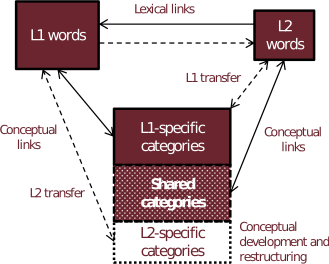

Figure 4: The Modified Hierarchical Model

Language transfer then is the result of “language competition” happening in the mind of a bilingual or multilingual person, and is also a sign of 1 language “winning” over another. We can also conclude that the influence languages have on one another in a person’s mind can be either positive (positive transfer) or negative (negative transfer or interference).

Positive transfer is represented by the so-called “true friends” – words in a foreign language that learners tend to acquire and remember more easily due to their phonetic forms (similar or identical to the ones in the native language), orthographic representations, or mere personal associations an individual can have between a word in his native language and a new word in L2.

“True friends” words typically have the same conceptual meanings in 2 languages, or alternatively they come from the same semantic fields. In contrast, negative transfer or interference can be found in the so-called “false friends”: these are words that either sound or are spelled identically, but have opposite or completely different meanings in two languages. Examples of negative transfer can trick learners into equating 2 words from L1 and L2 with a single concept, though this is not the case.

Why was it important for us to know in which ways languages can affect each other? The answer is simple: we can use this information to enhance our teaching or learning techniques.

There are some important implications for teaching and learning we can draw from the models and experiments discussed. The first one is the ways concepts in L1 and L2 interact with each other.

If they are fully equivalent, then a learner only has a task of acquiring a new word in L2 and linking it with the existing conceptual representation. In this case, a positive transfer is at work.

However, some concepts in different languages can have various boundaries, overlapping or excluding some aspects. Lack of awareness of such differences may lead to language interference and non-native like performance.

In the 3rd scenario, it is also possible that some concepts are unique for a certain language, but are non-existent in the other. Non-equivalence, on a brighter side, does not involve any sort of interference for learners, because it requires establishing a new concept within the conceptual store and linking it to a new word in L2.

Finally, we can conclude that language interference in the mind is a multi-faceted phenomenon in psycholinguistics that will attract more attention as bilingualism and multilingualism are getting more common in the world today. More research still needs to be done to either prove hypotheses and models suggested up to now or provide new ones.