
The original experiment aimed at exploring the connection (if any) between knowing cognates in the non-dominant languages and thus performing in L1 better in cases where words from all languages have cognates. Cognates are defined as words in different languages having the same meaning and very similar (or identical) spelling and pronunciation.
Original lexical decision experiment involved trilinguals (L1 – Dutch, L2 – English, L3 - French) who had to distinguish between a word and a pseudoword in their native language by pressing a button on the right of the keyboard for “It is a word” response and on the left of the keyboard for “This word does not exist” response. Response times for cognates and noncognates were measured and compared. Three factors were important in the original experiment: the native context of experiment; the participants’ language expectations about the experiment (they were not aware that their foreign language knowledge was important for the task); and the participants’ fluency in all 3 languages.
The results of the original experiment demonstrated that the response time was shorter for a word which had a cognate in L2 than for a word without a cognate (the participants’ fluency in L3 was not strong enough to exert any influence on L1 performance, according to the authors of the experiment). Thus, it was concluded that word processing in the dominant language (L1) was influenced by weaker language(s) knowledge. Cognates in non-dominant languages (L2, L3) tend to help speakers process their native language (L1) faster.
Experiment 3: Read
Furthermore, based on the original experiment and the experiment presented on our website, we may assume that bilingual (and trilingual; multilingual for that matter) language processing leads to language conflict in the brain. Recent behavioural research indicates that words of all languages a person knows are stored in a common lexicon, and nontarget words are activated even if the situation requires knowledge of vocabulary in only a certain language.
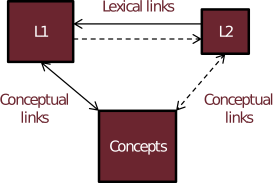
Figure 2: Kroll’s Revised Hierarchical Model
This fact leads us to believe that blocking nontarget language(s) is not possible even in a single-language context. Also we can conclude that the mental lexicon of bilinguals is organized on the basis of item characteristics rather than by language (language-nonselective context), which means parallel word activation even if a speaker is required to perform in a native language and in a purely native language context.
Interference, defined as a negative language transfer, is, thus, a result of language conflict in a person’s brain, which can affect both L1->L2 link as well as go in the opposite direction, L2->L1, as can be seen from the experiments.