This experiment is intended for anyone who does not speak Indonesian. This experiment is divided into two parts: Vocabulary Learning and Vocabulary Test. In the Vocabulary Learning, participants were asked to learn 15 words in Indonesian. These words appeared in pairs with their English translations. There was a time limit for this part, which was 5 seconds for each pair. At the end of this Vocabulary Learning, a review list containing all words was presented for 10 seconds before participants were asked to do the Vocabulary Test. In the Vocabulary Test, participants were asked to type-in the correct Indonesian words for the given English words. All answers were recorded and analyzed.
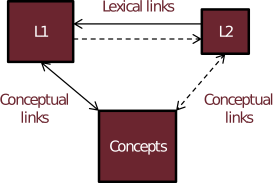
This experiment aims to spot and prove the presence of language transfer during language acquisition in bilingual and multilingual learners. Language transfer can be divided into 2 categories: positive transfer and negative transfer. When you learn a new language, the knowledge of your native language (L1) or your second language (L2) may have a huge impact on your learning process. The knowledge of your native language or your second language may help you to remember and to produce the target language items of the new language; this phenomenon is referred to as positive transfer.
During this experiment you probably noticed that some words are easier to learn and remember than others due to these reasons:
1. These words have cognates in your native language (L1) or in your second language (L2). For example, the word “tante” in Indonesian was borrowed from Dutch, where the word “tante” means “aunty”. This word not only has a cognate in Dutch but also in German. Because of this, for Dutch and German speakers Indonesian words like this one might be easier to learn and remember.
2. The similarity of the words' orthographical and phonological shapes help you learn them faster. For example, the Indonesian word “alergi” and the English word “allergy”.
3. You can draw the mental images or build phonological associations between foreign words and their meanings. These associations make these foreign words memorable for you (L2 is associatively linked to L1). The word “kamar” in Indonesian originally came from the Dutch word “kamer” which means "room". Russian speakers may learn this word by making associations. This process has two steps: firstly, they start by building phonological associations with a Russian word “mosquito” which sounds the same as the word “kamar”. Secondly, they continue by drawing the mental images in their mind featuring a mosquito in the bedroom to learn this word faster.