Experiment 1: Read

Have you ever considered how bilingual language information is stored and processed in your mind? This experiment aims to explain the organization of the bilingual mental lexicon, the connection between the lexicon and our concepts, as well as the interaction between different lexicons (if there is more than one). The procedure is rather simple: participants (German native speakers) were asked to accomplish 10 translation tasks including 5 translations from English to German and 5 translations from German to English. There was no spoken or written input involved. Participants only needed to press the “Next” button when they decided on the answer for each task. Response times were calculated and compared.
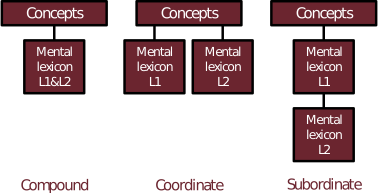
Figure 1: Possible Types of the Organization of the Mental Lexicon

Weinreich’s three models were among the first attempts in the illustration of bilingualism organization. In compound model, L1 and L2 lexicons are mixed and they access the concepts as one entity. Coordinate model postulates that L1 and L2 are stored separately, and they have independent access to concepts. In subordinate model, L1 and L2 lexicons are also separated, moreover, L2 is attached to L1 and does not access concepts directly. The question is which assumption is closer to reality?
In our experiment, you have probably noticed that translation from L2 to L1 is faster than translation from L1 to L2. This result has also been proven in Kroll’s experiment of testing lexical fluency of second language. According to Kroll, L2 to L1 translation is accomplished on the lexical level, whereas L1 to L2 translation needs to go through conceptual level. Apparently, compound and coordinate models are insufficient in explaining these two translation routines, since the interactions between lexicons seem to be vague in these models. However, subordinate model provides us with the primary insights that two lexicons are separated, and L2 lexicon is connected with concepts via L1.

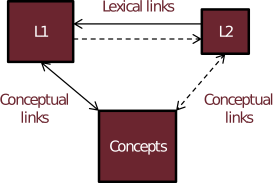
Figure 2: Kroll’s Revised Hierarchical Model

To better understand the translation asymmetry, we introduce Hierarchical Bilingual Model in which two lexicons are linked to concepts and to each other; additionally, different strengths of the links are represented. As you can see from the model, lexical links from L2 to L1 are assumed to be stronger because language learners learn a L2 word through the translation written in L1, which also explains why L2 to L1 translation is faster. By contrast, lexical associations from L1 to L2 are weaker, which causes a slower response in L1 to L2 translation, since the conceptual mediation is required. However, the time disparity decreases with the increase of L2 proficiency.

Next Experiment »